For startups and enterprises alike, the race to scale quickly, reduce costs, and stay competitive is fiercer than ever. Traditional on-premise software can’t keep up with these demands, it is slow, expensive, and difficult to scale. That’s why more businesses are turning to multi-tenant SaaS platforms built on the cloud.
Unlike legacy software, a SaaS platform allows multiple customers (tenants) to securely share the same infrastructure while enjoying isolated data, consistent performance, and instant access to new features. The result? Faster time-to-market, lower infrastructure costs, simplified maintenance, and global scalability.
Blog contents
At Bravado Solutions, we work with startups and enterprises to design future-ready SaaS platforms on AWS that combine scalability, security, and cost efficiency. Whether you are a fast-growing startup aiming for rapid market entry or an enterprise modernizing your applications, a multi-tenant SaaS architecture can give you the foundation to grow with confidence.
In this blog, we’ll break down what multi-tenant SaaS architecture is, its key components, and how the right deployment model can directly impact your growth, compliance, and ROI.
What is a Multi-Tenant SaaS Solution?
A multi-tenant SaaS solution is a cloud architecture where a single software instance serves multiple customers (tenants). Each tenant’s data is isolated, while infrastructure and resources are shared. Examples include Salesforce or HubSpot, where thousands of businesses use the same platform, yet each has isolated data and workflows.
Multi-tenant architecture provides several key advantages for SaaS providers and their customers such as:
- Rapid Scalability: Add new customers without creating separate environments for each, allowing your platform to grow effortlessly as demand increases.
- Instant Updates and Maintenance: Deploy features, enhancements, and security patches to all tenants simultaneously, ensuring consistent performance and reducing operational overhead.
- Cost Efficiency: Share infrastructure, computing resources, and storage across multiple tenants, lowering operational costs while maintaining high performance and reliability.
Key Components of a Multi-Tenant SaaS Architecture
1. SaaS Applications
A SaaS environment typically consists of several core applications that work together to deliver a seamless experience for both providers and tenants. These applications are often built using modern web frameworks like React or Angular, ensuring responsive frontends that integrate seamlessly with backend microservices for scalability, performance, and security.
- Admin Console: The admin console is the control center for SaaS providers. It allows administrators to manage tenants, configure settings, monitor usage, and oversee the overall health of the platform. This ensures efficient multi-tenant management, compliance, and smooth operations.
- Sign-Up Application: The sign-up app serves as a public-facing registration portal, enabling new tenants to onboard quickly. From account creation to tier selection, this application streamlines the tenant onboarding process, ensuring that businesses can start using the SaaS platform without delays.
- Tenant Applications: Tenant applications are the core business tools within a SaaS platform. These may include e-commerce systems, analytics dashboards, CRM platforms, or industry-specific solutions that tenants rely on to access the platform’s main features. They deliver daily operational value by enabling businesses to sell products, analyze performance data, manage customer relationships, and streamline workflows.
2. Deployment Models in Multi-Tenant SaaS
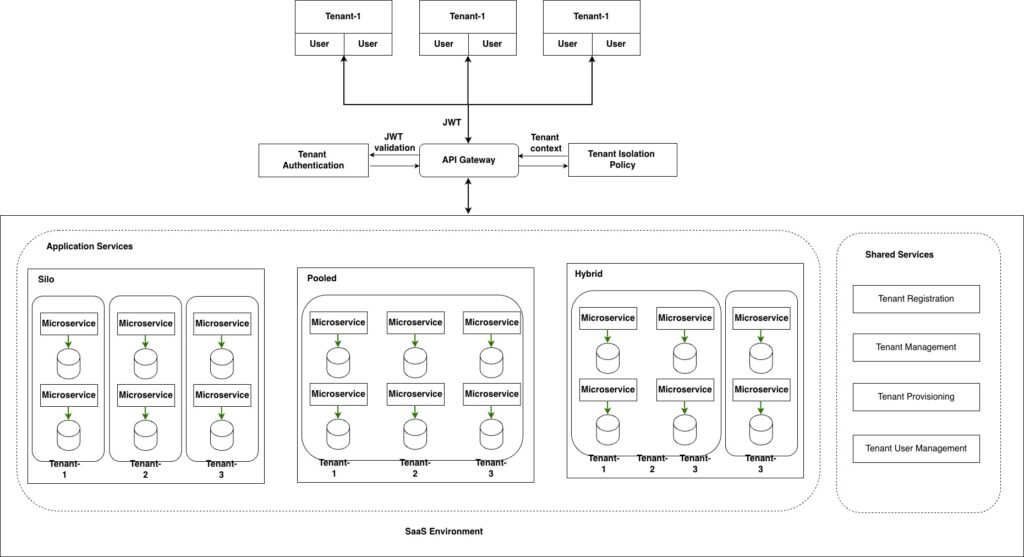
At the heart of every SaaS application is the business logic layer, which drives critical operations such as order management, payment processing, product catalogs, billing, and customer workflows. To serve thousands of tenants efficiently, modern SaaS platforms use a microservices architecture that breaks these functions into modular, independently deployable services. This approach enables faster updates, stronger fault isolation, and flexible scaling, ensuring the application remains reliable and adaptable as demand grows. When deploying application services in a multi-tenant SaaS environment, providers typically adopt one of two strategies:
- Pooled Model
In the pooled deployment model, multiple tenants share the same set of application services and databases. This approach is highly cost-efficient and simplifies maintenance since updates and bug fixes are rolled out centrally. It works best for small to mid-sized tenants who prioritize affordability and rapid onboarding over dedicated resources. - Silo Model
In the siloed deployment model, premium tenants are provided with dedicated services and isolated databases, ensuring maximum data security, compliance, and performance guarantees. This model is ideal for enterprise customers in highly regulated industries such as finance, healthcare, and government, where strict data segregation is essential. - Hybrid SaaS Model
Many modern SaaS platforms combine both pooled and silo models in a hybrid deployment strategy. This allows providers to offer tier-based pricing plans, giving smaller customers a cost-effective shared model while offering premium or enterprise clients a dedicated, fully isolated environment. The hybrid approach strikes a balance between scalability, cost optimization, and compliance requirements—making it the most widely adopted strategy in multi-tenant SaaS today.
3. Shared Services in Multi-Tenant SaaS
Shared services are the foundation that makes modern SaaS platforms scalable, secure, and efficient. By consolidating core functions into a centralized layer, SaaS providers can support thousands of tenants while maintaining consistency, cost efficiency, and compliance. This architecture ensures that every tenant enjoys a seamless experience without compromising on security or performance. Key shared services include:
- Authentication & Identity Management: Centralized identity services with SSO, MFA, and RBAC provide secure and seamless access. This strengthens data protection while ensuring users only access resources relevant to their role.
- Tenant Onboarding & Provisioning: Automated onboarding handles account creation, tier setup, and resource provisioning, enabling tenants to start quickly and at scale without manual effort.
- Lifecycle Management: Lifecycle automation manages upgrades, downgrades, renewals, and terminations, aligning resources with tenant needs while supporting usage-based billing.
- Policy Enforcement & Compliance: Centralized policy enforcement ensures consistent security, access controls, and regulatory compliance (e.g., GDPR, HIPAA) across all tenants, reducing risk and maintaining trust.
4. Multi-Tenant Data Storage in SaaS
Data is the most valuable asset in any SaaS platform, and how it is stored directly affects security, performance, scalability, and compliance. In multi-tenant architectures, careful planning is essential to balance efficiency with data isolation. Common data storage approaches include:
- Shared Database (Pooled Tenants)
All tenants share a single database, with data separated using tenant IDs or partitioning keys. This is cost-efficient and easy to maintain but requires strong access controls and encryption to ensure data security. Ideal for startups and small businesses. - Dedicated Database (Silo Tenants)
Premium or enterprise tenants get dedicated databases or isolated schemas. This ensures full data isolation, high performance, and compliance with strict regulations, making it suitable for finance, healthcare, and government clients. - Tiered Storage Strategy
A hybrid approach combines shared and dedicated storage, offering cost-effective options for smaller tenants while providing secure, isolated databases for high-value or regulated clients. This balances cost, security, and compliance across tenant tiers.
5.CI/CD Pipeline in SaaS
DevOps automation is key to delivering modern SaaS platforms at scale. Automating the build, test, and deployment processes allows SaaS providers to release updates quickly, maintain high reliability, and ensure a seamless experience for all tenants. The key features of a SaaS CI/CD Pipeline include:
- Automated Build & Testing
Automation ensures every code change passes through unit, integration, and end-to-end (E2E) tests before deployment. This maintains code quality, detects regressions early, and prevents issues from reaching production. - Seamless Deployment for Pooled Tenants
For shared (pooled) environments, updates are rolled out centrally across all tenants. This enables rapid, zero-downtime deployments, ensuring every user benefits from the latest features and security patches simultaneously. - Dedicated Provisioning for Silo Tenants
For enterprise or silo tenants, the CI/CD pipeline automates individual environment provisioning and deployments. Each tenant receives isolated infrastructure, ensuring customization, performance, and compliance without affecting others. - Infrastructure as Code (IaC)
By defining infrastructure using IaC tools like Terraform or AWS CloudFormation, providers can spin up consistent, repeatable environments. This reduces human error, supports version control, and enables scalable infrastructure automation. - Monitoring & Rollbacks
Continuous monitoring tracks performance and deployment health in real time. If errors are detected, automated rollbacks ensure minimal disruption and maintain uptime across all tenant environments.
6.Multi-Tenant SaaS Security Best Practices
Security and data isolation are fundamental in multi-tenant SaaS platforms. With multiple tenants sharing the same application environment, providers must implement robust security measures to protect sensitive data, maintain compliance, and preserve customer trust. A layered approach to access control ensures both security and scalability.
- Centralized Identity Providers
Modern SaaS platforms rely on centralized identity providers to deliver secure and consistent authentication across all tenants. Features like Single Sign-On (SSO), Multi-Factor Authentication (MFA), and Role-Based Access Control (RBAC) ensure users can access services safely while maintaining a seamless login experience. This unified identity layer strengthens compliance and simplifies user management across applications. - Tenant-Aware Policies
Security in a multi-tenant architecture depends on tenant-aware access controls. These policies enforce strict separation at the database, API, and service levels, ensuring that each tenant only accesses their own data and operations. By embedding tenant context into every request, SaaS providers can guarantee data isolation and maintain high trust across shared environments. - Scoped Credentials & Short-Lived Tokens
To enhance data security, SaaS platforms use scoped credentials and short-lived tokens for all access operations. These temporary credentials minimize exposure risks, limit unauthorized access, and ensure that even if a token is compromised, it expires quickly. This approach aligns with zero-trust principles and is essential for protecting sensitive data in dynamic cloud environments.
7.Tier-Based Throttling in Multi-Tenant SaaS
In a multi-tenant SaaS environment, not all tenants have the same performance requirements. Some customers use the platform lightly, while others demand high availability, throughput, and advanced features. To maintain balance, SaaS providers implement tier-based throttling, which aligns system performance with pricing models and ensures fair resource distribution.
- Basic Tenants
For entry-level or budget plans, SaaS platforms apply stricter request and usage limits to maintain affordability. This helps conserve system resources while still delivering reliable functionality for smaller workloads. - Premium Tenants
High-value or enterprise customers enjoy higher throughput, faster response times, and defined SLAs. These tenants often receive priority processing, ensuring consistent performance even during traffic spikes or heavy workloads.
8.Observability and Cost Tracking in Multi-Tenant SaaS
In a multi-tenant SaaS platform, visibility into tenant activity is crucial for maintaining performance, reliability, and profitability. By embedding tenant-aware observability throughout the system, SaaS providers can monitor usage patterns, detect issues early, and accurately track operational costs per tenant.
- Tenant-Aware Logging & Monitoring
Through tenant-specific logs, metrics, and dashboards, providers gain deep visibility into each tenant’s behavior and performance. This granular monitoring helps identify slow queries, resource-heavy tenants, and usage trends — ensuring optimized performance across shared environments. - Proactive Detection
Advanced monitoring tools enable early detection of anomalies, bottlenecks, and usage spikes, helping teams respond before they affect end users. This proactive approach improves system reliability, reduces downtime, and enhances customer satisfaction. - Cost Tracking per Tenant
By implementing per-tenant cost tracking, SaaS providers can measure infrastructure consumption and operational expenses for each customer. This enables usage-based billing and transparent pricing, allowing providers to align costs with actual resource utilization and optimize profitability.
Partner with Bravado Solutions for your SaaS Success
At Bravado Solutions, we specialize in designing, building, and scaling cloud-native multi-tenant SaaS platforms that deliver measurable business value. Our expertise spans SaaS architecture design, DevOps automation, and AWS cloud engineering, enabling organizations to launch faster, reduce costs, and scale confidently. Whether you are a startup launching a SaaS product or an enterprise modernizing mission-critical applications, we provide the technical foundation for long-term SaaS success.
Secure and Compliant SaaS Architecture
Security is built into every SaaS solution we deliver. We implement tenant isolation, end-to-end encryption, and advanced identity management from the ground up. Our SaaS designs comply with GDPR, HIPAA, SOC 2, and other global security standards, ensuring regulatory compliance while maintaining high availability and customer trust across both shared and dedicated environments.
Cost-Optimized Multi-Tenant SaaS for Maximum ROI
Tenant isolation is fundamental to success in multi-tenant context. Our hybrid SaaS architecture strategy delivers the best of both worlds i.e cost efficiency for smaller tenants and enterprise-grade performance for premium clients. By combining pooled resources for startups and siloed deployments for regulated enterprises, we help SaaS providers reduce cloud costs, maximize ROI, and deliver tailored user experiences across multiple customer tiers.
DevOps Automation and CI/CD for Faster SaaS Deployment
We accelerate your time-to-market with fully automated CI/CD pipelines and Infrastructure as Code (IaC). This enables zero-downtime deployments, faster feature rollouts, and consistent infrastructure across all environments. By embedding DevOps automation, we help SaaS providers achieve reliable, repeatable, and scalable deployments while minimizing manual effort and operational risks.
Final Thoughts: Building SaaS That Scales With Your Business
A well-architected multi-tenant SaaS platform is more than just technology, it’s a catalyst for business growth. By ensuring tenant isolation, optimizing shared infrastructure, automating deployments, and integrating enterprise-grade security, SaaS providers can deliver scalable, secure, and cost-efficient services to thousands of customers from a unified platform.
For startups, this translates to faster go-to-market, lower upfront costs, and seamless scalability. For enterprises, it ensures compliance-ready systems, improved ROI, and the agility to serve global markets without technical constraints.
Bravado Solutions is an award-winning SaaS development company. We don’t just build software, we build the technical foundation for long-term SaaS success. From architecture design to DevOps automation, our approach ensures your SaaS product is secure, cost-optimized, and built for sustainable growth.