
What is Agentic AI?
Agentic AI is an enterprise AI architecture where systems can understand goals, plan multi-step actions, retrieve relevant contextual data, and execute workflows autonomously using LLMs, tools, and APIs.
In modern enterprise environments, these systems are increasingly referred to as enterprise AI agents, because they behave like autonomous operators embedded inside business workflows. Unlike traditional AI systems or RAG pipelines, Agentic AI does not stop at generating responses—it completes tasks end-to-end. This architectural shift is what separates experimental AI tooling from production-grade enterprise AI development.
It represents the shift from:
AI as an assistant → AI as an autonomous operator
This evolution is also the foundation of modern LLM agent architecture, where intelligence is no longer passive but action-driven.
The Shift Enterprises Can't Ignore in 2026
Over the past few years, Retrieval-Augmented Generation (RAG) has become the default entry point for enterprise AI adoption. The concept was simple: connect Large Language Models (LLMs) to enterprise knowledge bases to improve factual accuracy and reduce hallucinations.
It worked extremely well in early-stage demos and internal prototypes. However, as organizations moved into production-scale deployments, a clear limitation emerged. RAG systems struggle when:
- • Tasks require multiple decision steps
- • Data exists across disconnected systems
- • Real-time execution is required
- • Business logic is not explicitly stored in documents
This creates a gap between information retrieval and operational execution. That gap becomes critical at enterprise scale. RAG is not obsolete — it is structurally incomplete for autonomous enterprise systems and cannot support autonomous AI workflows or full-scale AI orchestration systems. Organizations running enterprise software at scale are finding this gap more costly with every passing quarter.
Why Traditional RAG Systems Fail in Enterprise Environments
Most Retrieval-Augmented Generation (RAG) implementations are fundamentally single-step retrieval systems. They answer questions—but they do not manage processes. Because of this, RAG cannot function as a foundation for enterprise AI agents operating in real production environments.
Core limitations of RAG in production:
Static Retrieval Model: RAG performs a one-time fetch from a vector database. If the first retrieval is incomplete, the system does not adapt.
No Iterative Reasoning Loop: There is no mechanism for self-correction, re-querying, or validation of results.
No Execution Capability: RAG systems cannot trigger APIs, update databases, or interact with enterprise tools.
Poor Multi-System Handling: Enterprise workflows typically span ERP systems, CRMs, internal APIs, and external services. RAG operates in isolation — it cannot orchestrate across them. This is a fundamental blocker for organizations building SaaS platforms or cloud-native systems that require real-time coordination.
RAG vs Agentic AI: The Enterprise Reality
| Capability | RAG Systems | Agentic AI Systems |
|---|---|---|
| Core Function | Retrieve information | Execute business actions |
| Reasoning | Limited | Multi-step planning |
| Execution | Not supported | Fully supported |
| Adaptability | Static | Dynamic + iterative |
| System Role | Knowledge assistant | Workflow engine |
| Enterprise Use | Q&A systems | Automation systems |
Key Insight: RAG helps organizations understand data. Agentic AI helps organizations act on data through autonomous AI workflows powered by LLM agent architecture.
Agentic AI Architecture: A Production-Grade Enterprise Model
Agentic AI introduces a continuous reasoning-execution loop, often called the Plan-and-Execute framework within modern AI orchestration systems. According to Gartner's analysis of intelligent AI agents, this architecture pattern is rapidly becoming the standard for enterprise AI deployments through 2026 and beyond.
1. Reasoning Layer (The Cognitive Engine)
Interprets intent and decomposes goals into executable steps. By 2026, this layer uses structured reasoning patterns to ensure the system evaluates before it acts. This is the core of modern LLM agent architecture, enabling enterprise AI agents to plan multi-step operations.
2. Retrieval Layer (The Context Engine)
Uses Hybrid Search — combining vector similarity for meaning and keyword matching for precision (IDs, SKUs, technical codes) to ensure data accuracy. This is essential for reliable autonomous AI workflows, especially in structured enterprise environments. Teams building on Azure or AWS have native tooling to support this layer at scale.
3. Orchestration Layer (The Control System)
Manages tool selection and logic flow. It enforces Deterministic Guardrails to ensure the AI stays within business logic and doesn't "improvise" outside its mandate. Frameworks like LangGraph and CrewAI are widely used at this layer to coordinate multi-agent execution.
4. Execution Layer (The Action Engine)
The "hands" of the system. It connects to ERPs, CRMs, and APIs via strictly defined JSON schema contracts, transforming reasoning into real-world operational actions. This is where enterprise AI agents transition from reasoning systems to operational systems — a capability that underpins offshore AI development engagements where integration depth matters most.
5. Memory & State Layer (The Continuity Engine)
Manages short-term working context and long-term persistent knowledge. It uses a State Machine pattern to track task progress, ensuring that the system "remembers" its place in a multi-step workflow even if a process is interrupted or requires human approval. This layer is critical for maintaining autonomous AI workflows across sessions.
This loop can repeat multiple times until the objective is completed.
Agentic AI Architecture (Enterprise Model)
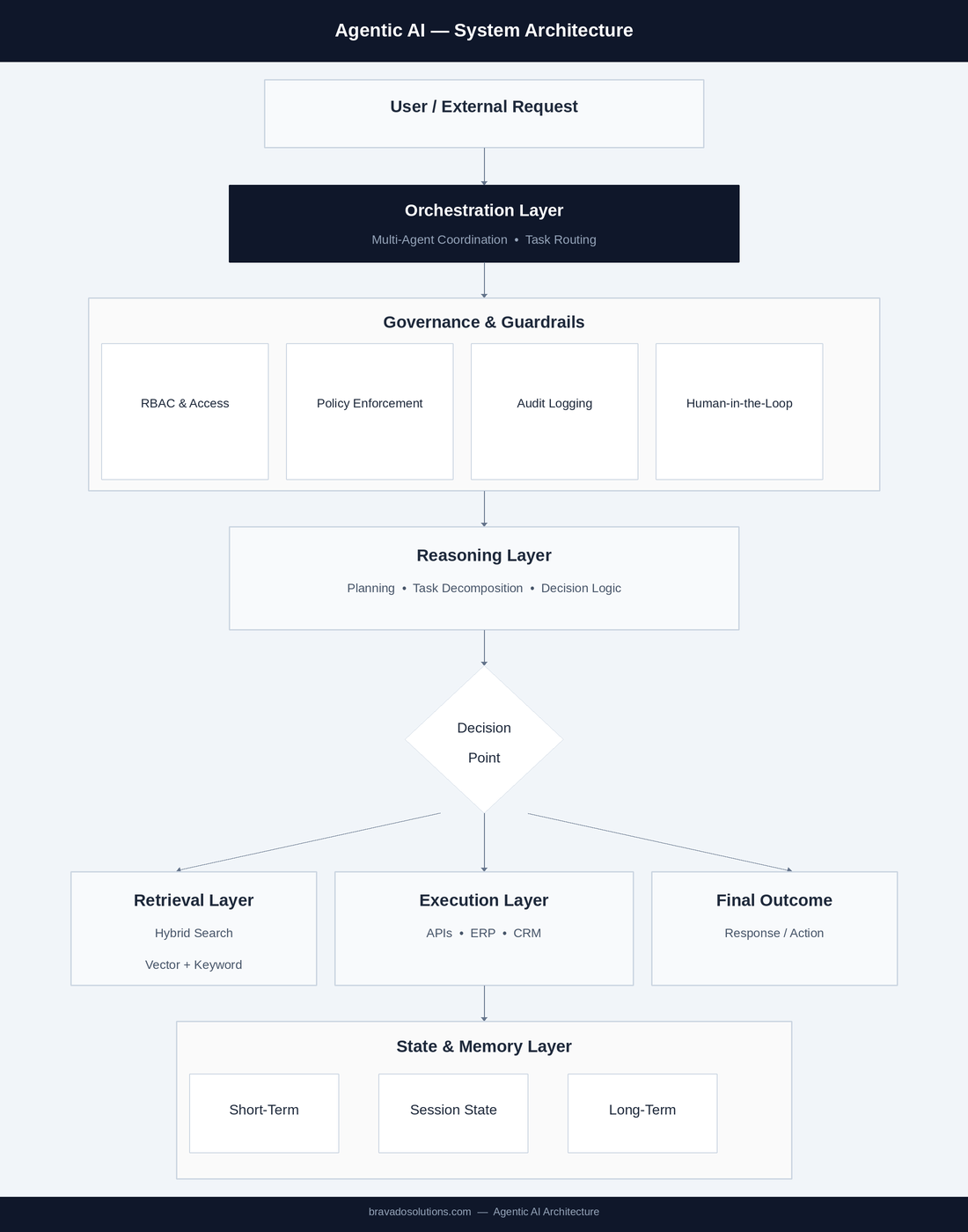
Multi-layer architecture powering enterprise Agentic AI systems
Real-World Example: From Insight to Autonomous Action
Consider a logistics or transportation system handling real-time operations — a scenario we explored in depth in our Empire Limousine agentic AI case study.
Traditional RAG:
Returns relevant documentation or policies based on a query. While informative, this does not directly resolve operational challenges.
Agentic AI:
Accesses live system data, evaluates constraints (availability/scheduling), optimizes decisions dynamically, executes updates across systems, and notifies stakeholders automatically.
This represents the shift from static intelligence to operational intelligence powered by enterprise AI agents and AI orchestration systems.
Hybrid Search in Agentic AI Systems
In enterprise environments, even small retrieval errors can cascade into incorrect decisions, making precision a non-negotiable requirement. Agentic AI systems rely heavily on the quality of retrieved context, and this is where traditional vector search alone falls short.
Pure vector search excels at capturing semantic meaning, but it often struggles with exact matches — especially when dealing with structured enterprise data such as IDs, SKUs, or technical codes. This creates gaps in accuracy that can directly impact downstream reasoning and execution.
Hybrid search solves this problem by combining two complementary approaches:
- Semantic embeddings for contextual understanding and intent matching
- Keyword-based retrieval for precise, exact matches
By blending these methods, hybrid search ensures that both meaning and specificity are preserved during retrieval. This significantly improves the reliability of agentic workflows, where decisions depend on both context and correctness. Teams deploying on Azure AI Search or Google Cloud's Vertex AI Search have mature hybrid retrieval capabilities available out of the box. In modern LLM agent architecture, hybrid search acts as a foundational retrieval layer for enterprise AI agents and autonomous AI workflows.
Token Optimization in Agentic AI Systems
In enterprise-grade Agentic AI systems, token usage is not just a cost factor — it is a core architectural constraint. Unlike traditional single-shot queries, agentic workflows involve multi-step reasoning loops, iterative retrieval, and tool interactions. Without proper optimization, token consumption can scale rapidly, making the system inefficient and expensive to operate. Designing for token efficiency ensures that Agentic AI systems remain scalable, responsive, and economically viable in production environments.
Key Strategies for Token Optimization
1. Small-to-Large Retrieval Strategy: Instead of loading large context windows upfront, the system begins with minimal, high-signal data and expands only when necessary. This approach reduces unnecessary token usage while maintaining accuracy, especially in multi-step reasoning scenarios.
2. Prompt Caching: System prompts, tool definitions, and repeated instructions are cached and reused across requests. This eliminates redundant token generation and significantly improves response latency in high-concurrency environments.
3. Model Routing (2026 Architecture Pattern): Modern Agentic AI systems use a multi-model approach, selecting the right model based on task complexity:
- Small Language Models (SLMs) (e.g., Phi-4, Mistral Small): Used for classification, routing, lightweight reasoning, and preprocessing tasks where speed and cost efficiency are critical.
- Large Language Models (LLMs) (e.g., GPT-class frontier models): Reserved for complex planning, multi-step reasoning, and decision synthesis where deeper intelligence is required.
This shift reflects a broader industry trend: from "one large model does everything" → to "specialized agents powered by the right model."
4. Semantic Efficiency Design: Retrieved context is optimized before being sent to the model. This includes compressing high-value information, removing irrelevant metadata, and prioritizing dense, decision-critical content. The goal is to maximize signal while minimizing token load.
Why Token Optimization Matters
Effective token optimization delivers measurable business impact:
- Lower cost per decision in production environments
- Faster response times for real-time workflows
- Improved scalability without linear cost growth
- Better resource utilization across SLM and LLM layers
In Agentic AI systems, performance is not just about intelligence — it's about efficiency. Token-optimized architectures are what separate experimental prototypes from production-ready enterprise systems. This matters especially when running multi-tenant cloud deployments where cost per inference is directly tied to margin.
State and Memory Management in Agentic AI Systems
Agentic AI is about remembering and maintaining context over time. One of the biggest differences from traditional RAG is the ability to maintain state across interactions.
🧩 Why Memory Matters
Without memory, the system treats every request as independent, leading to higher token costs, lower accuracy, and broken workflows.
🏗️ Types of Memory
- Short-Term Memory (Working Context): Temporary context used during a single agent run (query, active reasoning, intermediate results).
- Session Memory (State Management Layer): Maintains continuity across multiple steps within the same workflow. It "remembers what it already tried."
- Long-Term Memory (Persistent Knowledge Layer): Retains user preferences and historical decisions across sessions, stored in vector and structured databases.
🔄 State Management in Workflows
Ensures the system knows its current step, what has been executed, and what still needs completion. A well-designed system uses a state machine pattern (Initialized → Planning → Executing → Completed) to ensure deterministic behavior. This is essential for reliable autonomous AI workflows and production-grade LLM agent architecture.
⚙️ Memory + State in Enterprise Architectures
Memory is handled by external infrastructure components: Redis for session state, Vector Databases (Qdrant, Azure AI Search) for long-term memory, and Relational Databases for audit trails and transactional state. These components are typically deployed within a secure cloud infrastructure to ensure data residency compliance and enterprise-grade availability.
Implementation Blueprint: How Enterprises Build Agentic AI
Step 1: Data Structuring & Metadata Design: Normalize data, preserve contextual metadata, and enforce access control layers.
Step 2: Embedding & Retrieval Optimization: Use hybrid indexing systems, optimize chunking strategies, and reduce noise in retrieval.
Step 3: Tool Definition Layer: Define strict APIs with no free-form database access or uncontrolled system writes. All actions must be schema-validated.
Step 4: Controlled Execution Framework: API-first architecture with approval-based execution for sensitive actions and safety guardrails. This is where choosing the right AWS, Azure, or Google Cloud deployment environment becomes a critical architectural decision.
Step 5: Observability & Monitoring: Track reasoning paths, tool usage patterns, failure points, and cost per decision.
Agentic AI Data Ingestion Pipeline
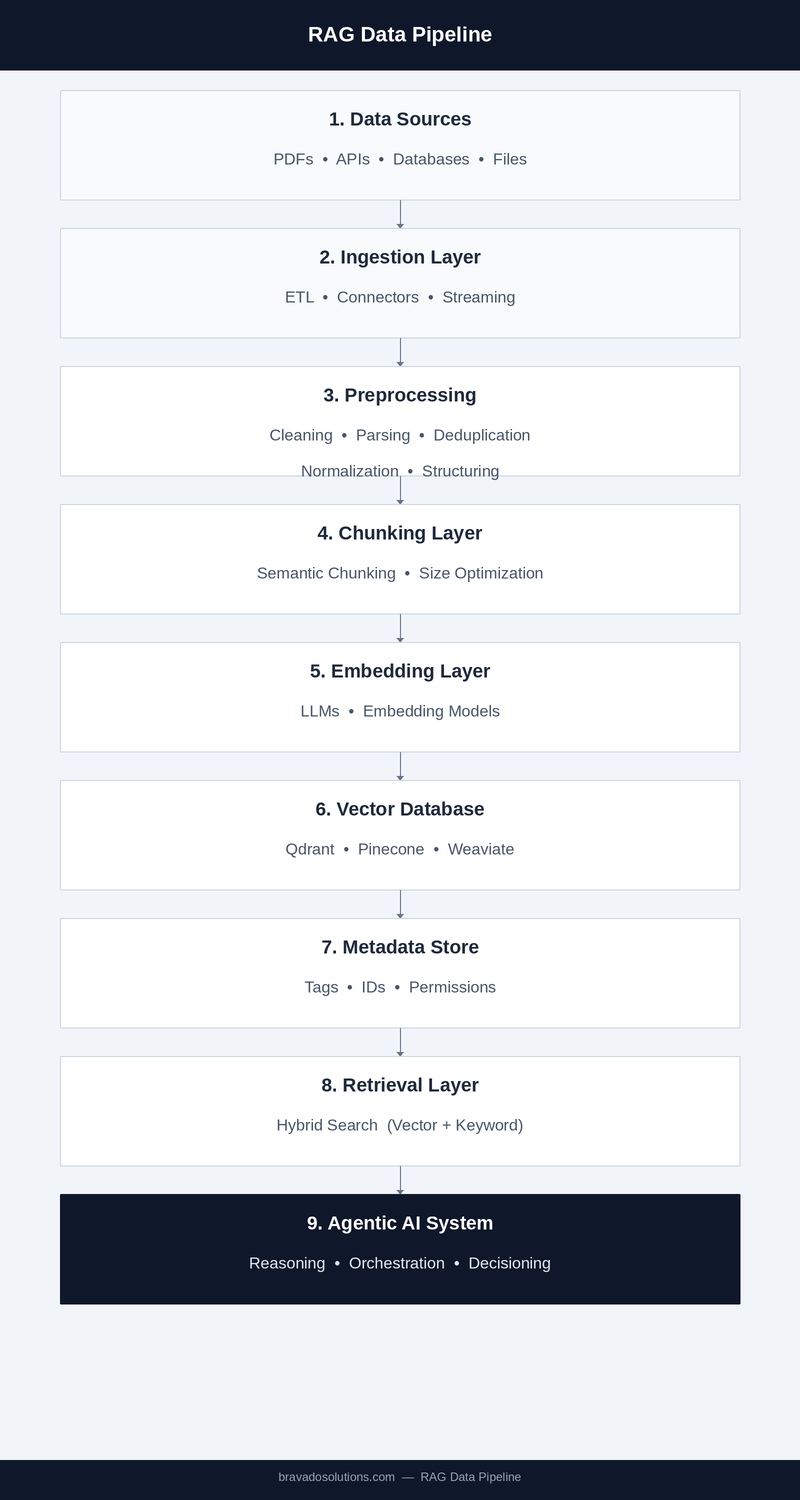
End-to-end ingestion flow: Data sources → preprocessing → chunking → embeddings → vector storage → retrieval layer
Agentic AI Case Study
Agentic AI Autonomous Dispatch System for Limo Booking and Fleet Management
This Agentic AI case study demonstrates a real-world enterprise deployment of an autonomous dispatch system designed for limousine booking, chauffeur assignment, and fleet coordination at scale:
Empire Limousine: Autonomous AI-powered dispatch and booking system
Bravado Solutions engineered a production-grade Agentic AI system capable of real-time route optimization, automated chauffeur assignment, and VIP booking management across a distributed fleet network — deployed on Microsoft Azure.
Hybrid Retrieval Core
Hybrid search using Azure AI Search with OCR and metadata normalization for high-accuracy dispatch decisions.
System Performance
- 120–180 ms retrieval latency
- 1.2–1.5s LLM reasoning time
- 99.97% system uptime
"The Agentic AI dispatch architecture built on Azure has become the backbone of our operational efficiency and growth."
— Empire Limousine
120ms
Latency
65%
Efficiency
2x
Scale
1M+
Chunks
Governance, Security, and Compliance
As systems become more autonomous, governance is critical. According to McKinsey's State of AI research, governance and risk management remain the top concerns for enterprises scaling AI into production. Requirements include:
- Role-based access control (RBAC) and Identity-aware retrieval.
- PII masking before model interaction.
- Full audit logging of every decision step.
- Human-in-the-Loop (HITL): Balanced autonomy where AI proposes actions but humans approve high-risk execution (financial operations, compliance).
All of these requirements are embedded into the agentic AI systems we build at Bravado Solutions, ensuring that autonomy never comes at the cost of control.
Common Failure Modes in Agentic AI Systems
While Agentic AI systems unlock powerful capabilities, production deployments reveal a different reality: poorly designed systems fail in predictable and often costly ways. Unlike traditional RAG pipelines, failures in agentic systems are not limited to incorrect answers — they can propagate across workflows, trigger incorrect actions, or stall execution entirely.
Some of the most common failure modes include:
- Infinite reasoning loops: The system repeatedly plans and re-plans without reaching execution, often due to weak termination conditions or unclear objectives.
- Incorrect tool selection: The agent chooses the wrong API or system for execution, leading to invalid actions or failed workflows.
- Retrieval drift across iterations: As the system re-queries data, context can gradually diverge from the original intent, resulting in inconsistent or incorrect decisions.
- State desynchronization between steps: The system loses track of progress, causing repeated actions, missed steps, or incomplete workflows.
In enterprise environments, these issues are not edge cases — they are systemic risks. This is why production-grade Agentic AI systems rely heavily on AI orchestration systems, deterministic guardrails, and observability layers to ensure reliability, traceability, and controlled execution. Autonomous AI workflows are only as reliable as the systems that govern them.
Enterprise Benefits of Agentic AI
Organizations adopting Agentic AI architecture achieve:
- Higher operational efficiency and reduced manual workload.
- Faster decision-making cycles and scalable automation.
- Reduced dependency on human coordination.
The Strategic Shift:
Phase 1: Information Access (Search, RAG)
Phase 2: Assistance (Chatbots, copilots)
Phase 3: Autonomous Systems (Agentic AI)
How to Get Started with Agentic AI
Organizations can adopt Agentic AI incrementally rather than replacing existing systems. A practical approach includes:
- Evaluating existing RAG systems
- Identifying multi-step workflows
- Introducing hybrid retrieval
- Defining controlled execution layers
- Adding orchestration and memory
This phased approach minimizes risk while enabling long-term scalability. For a detailed walkthrough of this journey, our agentic AI guide covers each phase with practical implementation guidance.
How Bravado Solutions Helps Enterprises Scale Agentic AI
At Bravado Solutions, we design and implement production-grade Agentic AI systems built for real enterprise environments — not prototypes or demos. Our focus is on turning AI from experimental capability into operational business infrastructure.
Our Core Services Include:
- Agentic AI architecture design for enterprise systems
- RAG-to-Agentic transformation and modernization
- End-to-end enterprise workflow automation
- AI governance, safety layers, and cost optimization
- Azure-based AI implementation and cloud scaling
- Agentic SaaS product development with multi-tenant AI architecture
- Offshore AI development teams for cost-efficient scale
We help enterprises move beyond RAG-based pilots into fully autonomous, scalable Agentic AI systems that integrate directly with business workflows.
Top Enterprise Use Cases of Agentic AI
Agentic AI is being adopted across industries where decision-making, automation, and multi-step workflows are critical to operations. IBM's research on agentic AI identifies autonomous workflow execution as the primary driver of enterprise adoption in 2025–2026.
- Logistics & Fleet Optimization: Real-time routing, dispatch automation, and dynamic resource allocation — as demonstrated in our Empire Limousine deployment.
- Financial Operations Automation: Invoice processing, reconciliation, fraud detection, and automated decision workflows.
- Customer Support Orchestration: Multi-step ticket resolution, intelligent routing, and autonomous support workflows across systems.
- Compliance Monitoring: Continuous policy enforcement, audit trail generation, and regulatory risk detection.
- Healthcare Operations: Patient scheduling, medical workflow automation, and intelligent triage support systems.
These use cases represent a shift from static AI systems to autonomous operational intelligence embedded directly into enterprise workflows.
Frequently Asked Questions (FAQ)
Why do most enterprise RAG systems fail in production?
Because they only retrieve information, not execute decisions. They lack reasoning loops, tool usage, and workflow automation needed for real business operations. Our agentic AI guide covers this transition in detail.
When should a company move from RAG to Agentic AI?
When workflows require multiple steps, system integrations (ERP/CRM/APIs), or real-time execution — not just Q&A or document retrieval. If your team is building enterprise-scale software, the threshold arrives earlier than most expect.
What is the biggest risk in building Agentic AI systems?
Lack of control and governance. Without proper orchestration, memory, and guardrails, agent systems can execute incorrect actions or enter infinite loops.
How do Agentic AI systems integrate with existing enterprise tools?
Through structured API layers, tool schemas, and orchestration frameworks that connect AI agents to ERP, CRM, databases, and external services securely. Cloud platforms like AWS, Azure, and Google Cloud each offer native tooling to support this integration at scale.
Is Agentic AI replacing RAG systems completely?
No. RAG is still a foundational retrieval layer, but Agentic AI extends it with reasoning, planning, memory, and execution capabilities.
The Future of Enterprise AI is Agentic
Enterprise AI is no longer about passive systems that retrieve information. It is evolving into active operators that reason, decide, and execute inside real business workflows.
• From retrieval → reasoning
• From answers → actions
• From tools → autonomous systems
The question is no longer:
"Can we build AI systems?"
It is now:
"Can our AI systems run the business?"
Ready to move beyond RAG and build real autonomous AI systems?
If your organization wants to design production-grade Agentic AI workflows, automate complex business processes, and scale enterprise AI safely and efficiently — Bravado Solutions can help you architect and deploy it.