
Case Study
HIPAA-Compliant Medical Billing Software for Revenue Cycle and Patient Management
Bravado Solutions developed a HIPAA-compliant medical billing software solution for AMBSI to streamline revenue cycle management, patient billing, and operational workflows in a secure, compliant environment. The platform improved efficiency, reduced manual work, and helped AMBSI deliver a smoother billing experience for both staff and patients.
Industry
Healthcare
Client
AMBSI
Project Team
8+ Engineers
Business Requirements
AMBSI is a US-based multi-specialty healthcare provider managing a large network of physicians, billing staff, and patients. Their legacy billing system had become a liability — driving up claim denials, slowing reimbursements, and creating serious HIPAA compliance exposure. Bravado Solutions designed and delivered a cloud-native, microservices-based billing platform on AWS that modernized their entire revenue cycle while meeting the strictest healthcare data security standards.AMBSI needed more than a software upgrade. Their outdated system was creating operational drag and regulatory risk at scale. We identified four core goals before writing a single line of code:
- Achieve full HIPAA compliance across data handling, storage, and transfer
- Reduce claim denials through automated coding validation and eligibility checks
- Accelerate reimbursements by automating claim processing and follow-ups
- Strengthen patient data security end to end throughout the billing lifecycle
Key Challenges
Before engagement, AMBSI was dealing with four interconnected problems that compounded each other:
- Compliance drift — HIPAA guidelines were evolving faster than their internal processes could keep up, creating ongoing audit risk
- Fragmented patient data — records were scattered across multiple disconnected systems, making consolidation slow and error-prone
- Manual billing processes — human-dependent workflows increased the chance of coding errors, denied claims, and confidentiality breaches
- Outdated security infrastructure — existing measures no longer met current HIPAA standards, leaving sensitive patient data exposed
Solution Approach
We approached this as an architecture problem first and a billing problem second. The solution needed to be modular enough to scale with AMBSI’s patient volumes, secure enough to satisfy HIPAA auditors, and reliable enough to run mission-critical billing workflows without downtime.Microservices Architecture
Rather than building a monolithic system, we broke the billing platform into independent services — each responsible for a specific function. This meant individual components could be updated, scaled, or replaced without disrupting the entire system. Services were containerized with Docker, orchestrated with Kubernetes, and deployed on AWS with auto-scaling built in.
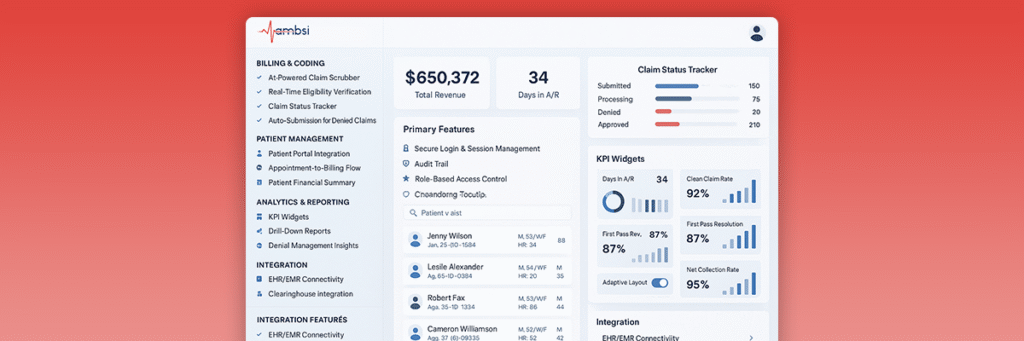
- Billing & Claims Processing — automated claim submission, eligibility verification, and error correction before submission
- Patient Management — unified patient records pulling from both EHR and billing systems, giving clinical and billing staff a single source of truth
- Payment Reconciliation — integrated with Stripe, PayPal, and insurance providers via encrypted APIs with full transaction logging
- Reporting & Analytics — real-time dashboards tracking claim denial rates, reimbursement timelines, and billing performance
- Notifications — automated AWS SNS alerts to patients on billing status and appointments
EHR Integration:
We built secure RESTful APIs to connect with AMBSI’s existing Electronic Health Record (EHR) systems, ensuring patient demographics, treatment details, and billing data moved between systems accurately and in an encrypted format — eliminating manual data re-entry entirely.
Security & HIPAA Compliance
Every layer of the platform was built with compliance in mind — not bolted on afterward. Key measures included end-to-end encryption for all patient data in transit and at rest, JWT token-based authentication with role-based access control, AWS CloudWatch audit logging, and a CI/CD pipeline with automated security testing before every deployment.
Results
The platform went live and delivered measurable impact across every metric that mattered to AMBSI’s leadership:- 35% reduction in claim denials — automated validation caught errors before submission
- 30% faster reimbursements — streamlined processing and automated follow-ups cut turnaround time significantly
- 25% reduction in administrative time — EHR integration eliminated manual data entry, freeing staff for patient-facing work
- Full HIPAA compliance achieved — regular audits confirmed all security and data handling requirements were met
Clutch Verified Review — AMBSI, Healthcare
"
We were dealing with an outdated system that created real compliance risks and slowed down critical operations. Since deployment of the new billing system, our team has reclaimed hours of manual work every day, our revenue cycle runs far more efficiently, and our patients are experiencing a smoother billing process. Bravado Solutions understood our regulatory requirements without needing overexplanation, and their execution throughout the project was exceptional.
AM
Director of IT & Compliance, AMBSI
US-based Multi-Specialty Healthcare Provider
Frequently Asked Questions
Common questions from healthcare providers, startups, and SMBs considering a custom medical billing software or HIPAA-compliant software development project.
How much does it cost to build HIPAA-compliant medical billing software?
+
Cost depends on the scope, complexity, and number of integrations required. A core medical billing platform with HIPAA compliance, claim processing, and EHR integration typically starts from $40,000 for an MVP-level build. A full enterprise-grade system like AMBSI — with microservices architecture, real-time analytics, role-based access control, and cloud infrastructure on AWS, ranges higher based on team size and timeline. We provide a detailed cost breakdown during our free discovery call.
How long does it take to build a medical billing system?
+
A lean MVP with core billing and claims processing typically takes 10–12 weeks. A full-featured platform with HIPAA compliance, EHR integrations, payment reconciliation, and real-time reporting — similar to what we built for AMBSI — typically takes 5–7 months with a dedicated team. Timelines are defined clearly during the discovery phase before development begins. Our custom software development process is structured to avoid scope creep and delays.
Can you build medical billing software for a small or mid-sized healthcare practice?
+
Yes. We work with healthcare providers of all sizes — from single-specialty clinics to multi-location practices. For smaller practices, we scope the solution to match your patient volume, team size, and budget — delivering only what you need without over-engineering. Our software development approach ensures the system fits your workflows rather than forcing you to adapt to generic software.
Do you sign a Business Associate Agreement (BAA) for HIPAA projects?
+
Yes. A Business Associate Agreement is a standard part of our engagement for any project involving Protected Health Information (PHI). We treat HIPAA compliance as an architectural requirement — not an afterthought — covering data encryption, access controls, audit logging, and breach notification procedures from day one. Our team has hands-on experience implementing HIPAA Security Rule requirements across cloud-native platforms on AWS.
Can the billing platform integrate with our existing EHR system?
+
Yes. We build secure RESTful API integrations with major Electronic Health Record (EHR) systems to ensure patient demographics, treatment details, and billing data transfer accurately and in an encrypted format — eliminating manual data re-entry entirely. For AMBSI, EHR integration reduced administrative time by 25% and significantly improved data accuracy across billing and clinical teams.
What AWS services do you use to ensure HIPAA compliance?
+
For the AMBSI platform we used a combination of AWS services specifically suited to HIPAA-eligible workloads — including AWS API Gateway for secure backend routing, AWS RDS for encrypted database storage, AWS CloudWatch for audit logging and monitoring, AWS SNS for automated notifications, and AWS Auto Scaling with Kubernetes for reliable performance under load. All data in transit and at rest was encrypted using industry-standard protocols, and a CI/CD pipeline was implemented for automated security testing before every deployment.
How did you reduce claim denials by 35% for AMBSI?
+
We implemented automated validation algorithms that check medical codes, verify insurance eligibility, and flag potential compliance issues before a claim is ever submitted. This removed the manual review bottleneck that was causing the majority of errors in AMBSI's legacy system. The result was a 35% reduction in claim denials and a 30% faster reimbursement turnaround — directly improving cash flow and reducing the administrative burden on billing staff.
Can the platform scale as our patient volume grows?
+
Yes. The AMBSI platform was built on a microservices architecture with horizontal auto-scaling on AWS — meaning individual services scale independently based on real-time load without affecting the rest of the system. Whether your patient volume doubles or triples, the infrastructure adjusts automatically. Our cloud development approach ensures you are never locked into fixed capacity or facing downtime during peak billing periods.
Do we own the source code after the project is complete?
+
Yes — full ownership. All source code, architecture documentation, and intellectual property are transferred to you upon project completion and final payment. You are never dependent on us to access or run your own system. This applies to every engagement whether we build a SaaS platform, a custom software solution, or a regulated healthcare system like AMBSI.
Do you provide support and maintenance after the billing system goes live?
+
Yes. We provide ongoing post-launch support covering performance monitoring, bug fixes, security updates, and regulatory changes that may affect HIPAA compliance. For cloud-hosted platforms we also manage infrastructure across AWS, Azure, and Google Cloud — ensuring your billing system stays fast, secure, and available as your practice grows.